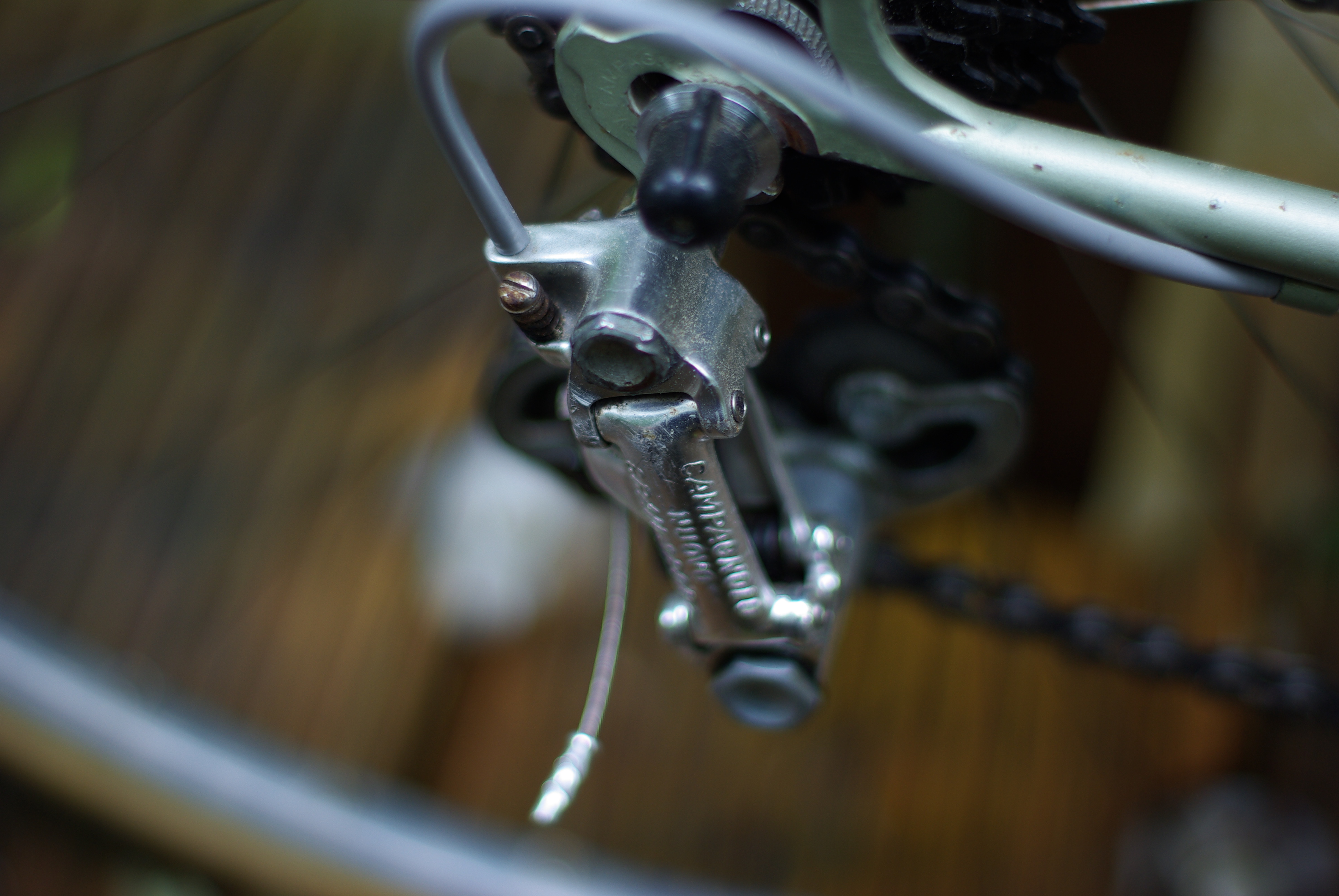
Nevertheless, Zeus Industriale SA was established in the Basque region in 1926 by Don Nicholás de Arregui in Eibar. Initially they produced small parts, then components and finally complete bicycles. In addition Nicholas de Arregui filed a few up to some patents until 1964.
Starting with 1958 a man called José Luis Eibar, who was acclaimed to be the owner of Zeus in an 1961 advert published in Le Cycliste did the same until about 1969.

Furthermore and in order to increase confusion, both Eibar and Arregui are names of Basque towns also.
Thus it fits well when one of the unprooven stories about Zeus tells, that Zeus invented the parallelogram derailleur in the 30s and therefore many years before the 1951 Gran Sport was introduced by Tullio Campagnolo, and prior to Cervino or Nivex and others also.
Well, Nivex had a parallelogram derailleur in 1938 that was produced in numbers. Disraeligears shows one from the french JIC or Super Inax company called Super Inax Sport Derailleur that dates back to 1946.

Surprisingly Zeus patents shown at Disraeligears start in the 40s only and show more likely copies of the Simplex Tour de France derailleur and derivations of the old pull-chain design. Same with the Zeus Gran Sport patent which dates back to 1952 making it more likely a copy of the 1951 introduced Campagnolo Gran Sport derailleur than the original beeing copied by Tullio.
Next some sources claim something like a secret up to a not really published (commercial) relationsship between Campagnolo and Zeus. On one hand Zeus should have been sub-contracted for ‘difficult’ production work like titanium axels, on other hand Zeus should have carried out design work for Campagnolo.
Again I can´t proof these stories but there could be something in some of this. It would be surprising if Campagnolo did not use sub-contractors for some component parts especially when demand was exceedingly high.
The third story surrounds Luis Ocaña´s 1973 victory at the Tour de France by claiming he won on a Zeus bike using Zeus gears, but the team Ocaña was riding for was sponsored by the French consumer goods company BIC and got their bicycles from Géminiani or Motobécane.
Indeed Ocaña rode for Fagor in 1968/69, beeing a Basque company and team, that might have been supported by Zeus. Thus it might be valid claiming that Ocaña won the spanish Championship in 1968 riding a Zeus and Zeus gears.
Nevertheless we reach out the seventies, when Zeus decided that instead of slavishly copying Campagnolo (with their Gran Sport and Criterium derailleurs and group sets) it might be a better idea to make the pace rather than following it.
In the mid of the seventies they introduced the Zeus 2000 group set

and their top of the line bicycle Zeus 2000 Superchronos.

Sometime in the late 1980’s or early 1990’s Zeus seemed to have ceased production. Orbea, also based near Eibar, had bought the name and produced a variety of parts and bicycles branded with the Zeus name until about 2002.
But back to this 1979 Zeus 2000 Superchronos bicycle:
Bottom Braket: Zeus 2000 Superchronos
Headset: Zeus 2000 Superchronos
Crankset: Zeus 2000 Superchronos
Front Derailleur: Zeus 2000 Superchronos
Rear Derailleur: Zeus 2000 Superchronos
Shift levers: Zeus 2000 Superchronos
Brake Lever: Zeus 2000 Superchronos
Brakes: Zeus 2000 Superchronos
Wheelset: Zeus 2000 Superchronos with MAVIC rims
Saddle: Zeus 2000 Superchronos
Seatpost: Zeus 2000 Superchronos
Stem: 3ttt
Handlebar: 3ttt
Pedals:Zeus 2000 Superchronos
Frame tubing: Reynolds 531 SL
Fork tubing: Reynolds 531 SL
Nevertheless we reach out the seventies, when Zeus decided that instead of slavishly copying Campagnolo (with their Gran Sport and Criterium derailleurs and group sets) it might be a better idea to make the pace rather than following it.
In the mid of the seventies they introduced the Zeus 2000 group set

and their top of the line bicycle Zeus 2000 Superchronos.

Sometime in the late 1980’s or early 1990’s Zeus seemed to have ceased production. Orbea, also based near Eibar, had bought the name and produced a variety of parts and bicycles branded with the Zeus name until about 2002.
But back to this 1979 Zeus 2000 Superchronos bicycle:
Bottom Braket: Zeus 2000 Superchronos
Headset: Zeus 2000 Superchronos
Crankset: Zeus 2000 Superchronos
Front Derailleur: Zeus 2000 Superchronos
Rear Derailleur: Zeus 2000 Superchronos
Shift levers: Zeus 2000 Superchronos
Brake Lever: Zeus 2000 Superchronos
Brakes: Zeus 2000 Superchronos
Wheelset: Zeus 2000 Superchronos with MAVIC rims
Saddle: Zeus 2000 Superchronos
Seatpost: Zeus 2000 Superchronos
Stem: 3ttt
Handlebar: 3ttt
Pedals:Zeus 2000 Superchronos
Frame tubing: Reynolds 531 SL
Fork tubing: Reynolds 531 SL
That´s the condition the Zeus was found by a friend of mine. The photography on top shows the state I´ve got it from this friend.